

Is Your Retaining Wall Ready for Storm Season?
Is Your Retaining Wall Ready for Storm Season?
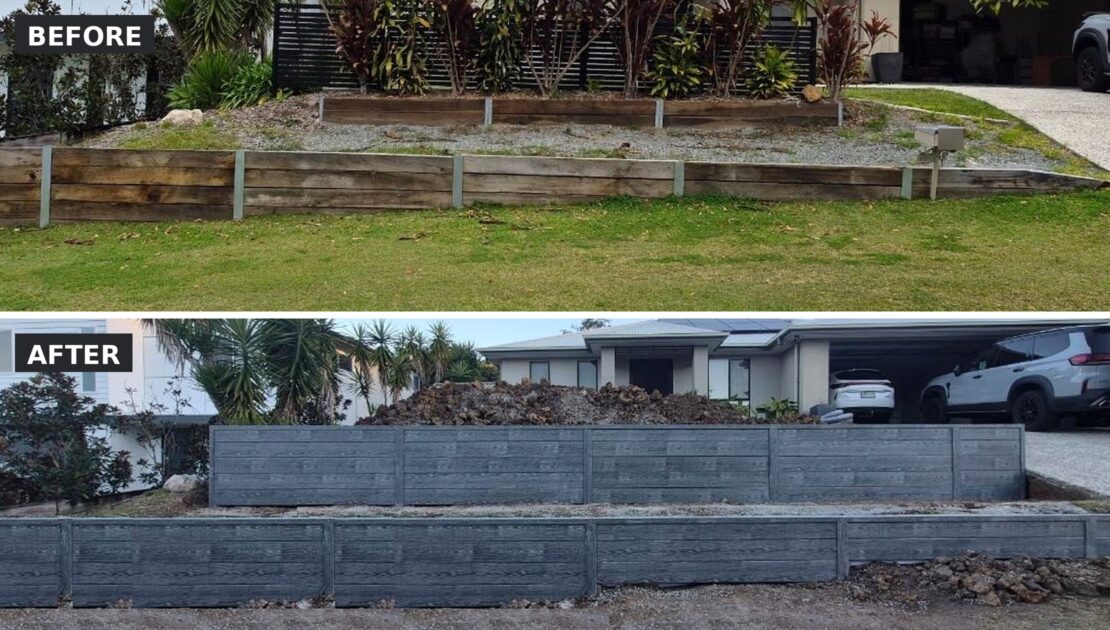
Storm season is here, and nothing tests a retaining wall like a week of heavy rain. A wall that’s looked “fine” all winter can start leaning, bulging or slumping once the soil behind it is soaked through.
If your timber sleepers are getting soft, or you’ve been meaning to fix that tired wall for a few years, now’s the time to check it. Here’s what to look for, why walls fail, and how TUFFPOLY makes replacing one quicker and easier than you’d think.
5 Signs Your Retaining Wall Is on Its Way Out
Take a walk along your wall before the big storms roll in. If you spot any of these, it’s time to start planning a replacement.
- Soft or crumbling sleepers: Push a screwdriver into the timber. If it sinks in easily, rot has set in, and it only gets worse from here.
- Leaning or bulging: A wall that’s tilting forward or bowing in the middle is losing the fight against the soil behind it.
- Gaps between sleepers: Soil washing through the joints means the wall is no longer holding its shape.
- Water pooling or seeping: Puddles at the base or a constantly damp face point to poor drainage behind the wall.
- Termite damage or rusted steel: Mud trails, hollow-sounding timber or rusting galvanised posts are all bad news for structural strength.
One sign on its own isn’t always urgent. A few together, heading into a wet summer, is worth acting on.
Why Walls Fail: It’s Usually the Water
Most retaining walls don’t fail because of the wall itself. They fail because of what’s behind it.
Wet soil is a lot heavier than dry soil. When rain soaks in and has nowhere to go, the pressure on the back of the wall builds up fast. Add timber that’s already softening from years of moisture, and something eventually gives.
That’s why a good retaining wall comes down to two things: a material that won’t break down when it’s wet, and drainage that gets the water out.
How a TUFFPOLY Wall Handles the Wet
TUFFPOLY sleepers and posts are a structural composite, so moisture simply doesn’t get a foothold. No rot, no rust, no termites, ever. But the material is only half the story. The TUFFPOLY install method builds drainage in from day one:
- Concrete piers: Posts are set in 450mm diameter, 25MPa concrete piers to anchor the wall.
- Crushed rock drainage: A 300mm thick layer of 20mm crushed rock behind the sleepers lets water drain freely instead of building up.
- Slotted ag pipe: A socked, slotted ag pipe at the base carries water away from the wall.
- Geofabric: Keeps soil from clogging the drainage rock over time.
- Soil plug: A minimum 100mm soil cap on top keeps surface water from pouring straight in.
The result is a wall that lets the water out and a material that doesn’t care if it gets wet. Full details, including post depths and span tables, are in the TUFFPOLY Install Guide and Install Video.
Replacing a Tired Wall? Why TUFFPOLY Is the Upgrade
Pulling out an old timber wall and starting fresh is the perfect chance to get it right for the long haul. Here’s why more landscapers and homeowners are making the switch:
- Light enough to carry by hand: Each sleeper weighs under 10kg. No machinery, which is a big win on tight backyards and hard-to-reach sites.
- Faster installs: Up to 75% labour savings compared with concrete and steel, so the job’s done before the next storm hits.
- Built for Aussie conditions: Moisture, UV and mould protection, and suitable even for corrosive coastal locations.
- Engineered and backed: Designed to comply with AS 4678-2002 Earth Retaining Structures, with a 60+ year design life and a 25-year structural warranty.
- No maintenance: No oiling, sealing or treating cut ends. A standard clean is all it needs.
- Looks the part: Natural timber-look sleepers and matching posts in two colours, Drift and Charcoal. Add a fence on top with TUFFPOLY galvanised fence brackets.
Before You Start: Check the Rules
Requirements vary from state to state, so check with your local council in the planning stage. In Queensland, any wall over 1m high needs to be assessed by an engineer. If your wall is within 1.5m of a building or another retaining wall, talk to a structural engineer or landscaper first.
Not keen to do it yourself? TUFFPOLY has installers in a number of areas. Find an installer and we’ll point you to someone local.
Final Word
A retaining wall should be something you build once and stop worrying about. If yours is rotting, leaning or holding water, don’t wait for the next downpour to make the decision for you.
TUFFPOLY gives you a wall that won’t rot, rust or wash out, without the heavy lifting.
Ready to get started?
- Measure the length and height of your wall.
- Plug the numbers into our Calculator to work out quantities.
- Request a quote and one of our Trusted Resellers will be in touch.